
We just locked in our Corporate Gold sponsorship with the Southern Academy of Pediatric Specialists for their meeting this November. The program came through last week and I read the whole thing top to bottom. The entire meeting is about AI in dentistry. Not a track, not one session buried on a Friday afternoon. The theme is The Intelligent Practice: AI, Innovation, and the Future of Pediatric Care, and it runs top to bottom through AI caries detection, AI radiographic interpretation, and AI treatment planning.
When an entire academy builds its annual meeting around one idea, that tells you where this industry is going.
Then I read it a second time and noticed something that nobody at that meeting is going to say out loud.

Click Here To See AI That Makes a Crown
Every Session Was About the Same Kind of AI in Dentistry
Look at what those tools actually do. One finds the caries. One reads the radiograph. One scores the case and flags the risk.
A smoke detector tells you the kitchen is on fire. It does not cook dinner.
Both things are worth owning. I am not knocking detection AI and neither should you. It catches what a tired eye misses at 4:30pm on a Thursday. It gives you a second opinion that never gets rushed. It backs up your call when a patient questions it six months later.
But watch what happens at the end of every one of those workflows. The AI finishes its job and hands the work right back to you. Same appointment. Same lab slip. Same two week wait. Same patient taking another half day off work to come back and get seated.
Detection AI makes you better informed. It does not make you faster.
Meanwhile every vendor in the hall has AI on the box. The word has turned into a sticker. Slap it on software that reads a picture, call it the future, and charge accordingly.
A question worth asking when a rep says the word AI to you….
Does it hand the work back to me, or does it finish something?
Ask it out loud and watch the slide deck stop working.
There Is a Second Kind and Almost Nobody Is Programming It
The second kind does not look at something and report back. It makes something.
I don’t know why the detection stuff got all the attention first. My best guess is that it demos well on a slide and it doesn’t require anybody to buy a machine. But that’s a guess, and I’d rather tell you it’s a guess than dress it up.
What I do know is what the second kind looks like when it’s sitting in a room.
What the Second Kind Looks Like Chairside
You scan. The Aoralscan weighs 106 grams and runs on a single USB-C cable. IntelliBite AI handles the bite registration for you. No impression material, no tray, no gagging, no retake because the patient moved at the wrong second. The scanner has interchangeable tips and the 12x9mm Mini tip fits a mouth that a full size tip does not, which matters a lot more than you’d expect the first time you’re working on a small patient or a tight posterior.
The AI designs the crown. Read that again, because this is the part everybody skims past. Not a suggestion. Not a rough starting point you spend twenty minutes cleaning up. A finished design that you review and approve. This step used to be a trained technician sitting at a workstation in a lab somewhere. Today it is a line item that costs about a dollar per crown at our 50 credit price.
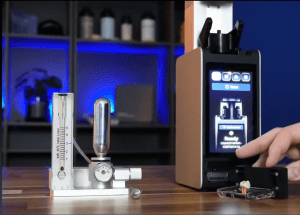
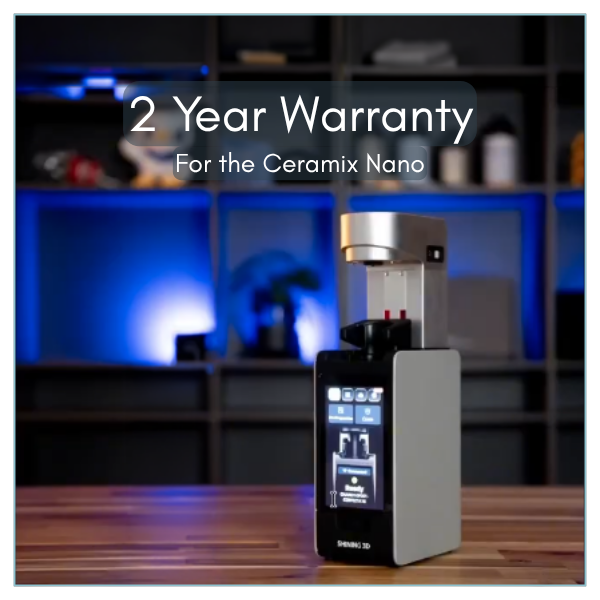
You print. The Ceramix Nano prints and cures a permanent restoration in 8 to 11 minutes. Curing is built into the same device, so nothing gets carried across the room to a second machine and nothing leaves the office. The whole unit weighs 4.6 lbs and sits on a counter, it’s about the same size as one of those mini Keurig coffee makers.
You seat it. Roughly 30 minutes chairside. One visit. No temporary. No second appointment. No lab courier. No two week wait.
AI touched three of those four steps. The lab touched none of them.
Credit where it belongs: Shining 3D built this, not us. We’ve been one of their certified dealers long enough to have watched them ship things that were early and things that were ready. This one is ready.
What a Crown Actually Costs You to Make
Everybody wants to talk about AI. Nobody wants to put a number on it. So here are ours.
A box of three capsules is $67, which comes to $22.33 per crown. The AI design is a dollar. Call it $23.33 in consumables per unit. Those are our published prices and you can go check both of them on our shop pages right now.
The printer is $5,999. Take your lab fee, subtract $23, and divide $5,999 by what’s left. That’s how many crowns it takes to cover the machine. Use your own invoice, not a number I made up. Most of the doctors I talk to are somewhere between $120 and $180 a unit, which puts you between 40 and 60 crowns. Go look at your own.
Sure, that math leaves out chair time. It leaves out the second appointment you never had to schedule, the temporary you never had to fabricate, the second numbing, and the remake because the temp came off in week two. Chair time is where the real money is and it isn’t anywhere in that formula.
It leaves out your learning curve too. Your first few units will take longer than your fiftieth. Everybody’s do. That’s what the training is for.
Now think about it in terms of paid crowns….
The Ceramix Nano prints a permanent restoration. Not a long term temporary, not a printed crown with an asterisk next to it. It bills as D2740, the same code as the crown your lab ships back to you. Same code, same fee. Nothing on the revenue side of your ledger changes at all.
What changes is the cost side. That crown cost you $23.
A D2740 runs somewhere in the neighborhood of $1,100 to $1,200 depending on your payer mix and your zip code. Six of those covers the printer.
Now I want to be careful here, because this is exactly where a rep starts lying to you. You were already collecting on those crowns when the lab was making them. The Nano didn’t create that revenue. It created the margin, and the margin is the $120 to $180 we already talked about.
Where six is the real number is the case you were going to lose. The patient who hears “two appointments” and books neither one. The patient who takes the temporary and never comes back to seat it. The patient who says let me think about it and thinks about it forever. Six of those, six crowns you were never going to do at all, and the machine is paid for.
Ask your front desk how many of those you had last month. That’s the number that matters, and I can’t tell you what it is. Only they can.
Now Here’s What the AI Doesn’t Do
This is the part every AI pitch leaves out, and I think leaving it out is exactly why so many dentists have their guard up.
It does not diagnose. It does not decide. It does not prep the tooth. It does not tell you the margin looks good.
You still do all of that. You review the design and you approve it before anything prints, which means when something is wrong you fix it while it’s still a file instead of after it’s a physical object sitting in a box on your front desk.
Another question you should be asking….
If the AI designs the crown, what’s left for me?
Everything that mattered in the first place. What the AI replaced isn’t your judgment. It’s the courier, the two week wait, and a technician you’ve never met designing a crown for a patient they’ve never seen.
The Southern Academy Is Early, Not Wrong
I want to be clear about them, because they earned it. They built an entire annual meeting around a topic most academies are still treating as a novelty session. That’s a real call and they made it before their peers did. If you treat kids, go.
AI in dentistry is going to keep showing up on programs, in journals, and in your equipment rep’s slide deck for the next several years running. That’s not a prediction. That’s just what happens once a topic gets its own annual meeting.
Most of what you hear about will be the first kind. Software that looks at things and tells you what it sees. Worth having. It will not change what your day looks like.
The second kind is already sitting in our demo room and it prints crowns.
If you’re still writing lab slips, still fabricating temporaries, still getting a shade call wrong two weeks after the patient left, or still watching a chair sit empty because somebody no-showed their seat appointment, go look at the Ceramix Nano.
Or schedule a demo and watch every step above happen live. It takes about 20 minutes. Bring your last lab invoice and we’ll run your numbers instead of ours. You can also check our FAQ page here, talk to us on our online chat, send an email to sales@sodiumdental.com, or give us a call at 1-800-821-8962.
Have a sensor, intraoral camera, handheld tubehead, or other easily shippable piece of dental technology that isn’t working? Send it our way, we can probably fix it. Submit your repair here.
Leave A Comment
You must be logged in to post a comment.