
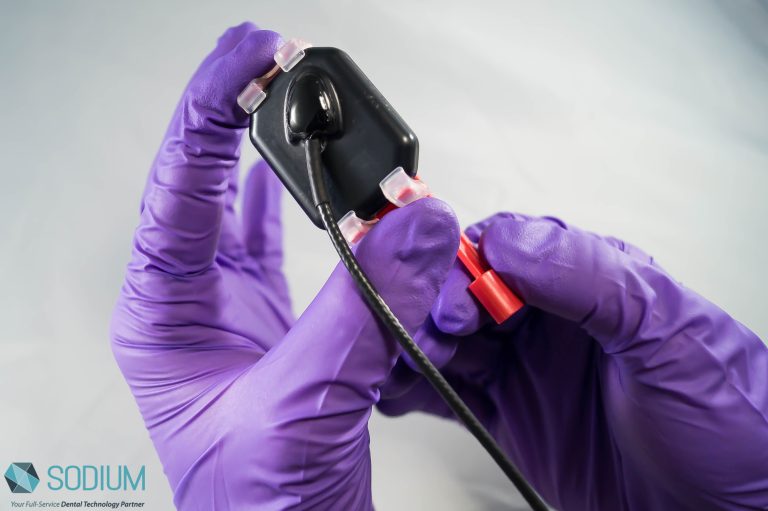
Pre-owned dental x-ray sensor in a holder during final bench testing at Sodium DentalIf you’re shopping for refurbished dental x-ray sensors, you’ve probably been quoted $8,000 to $10,000 for a new one and you’re wondering if there’s a smarter way to go. There is. But the word “refurbished” on a listing doesn’t tell you much, and the answer to “is it as good as new?” depends entirely on who had it on their bench before you.

We sell pre-owned dental x-ray sensors, and we’ve been repairing sensors since 2011. Here’s what actually wears out on a sensor, what “refurbished” does and doesn’t mean, and the questions to ask any seller before you buy.

Refurbished vs. Pre-Owned Dental X-Ray Sensors

There’s no standard for the word “refurbished.” One seller uses it for a sensor that was opened up, repaired and tested. Another uses it for a sensor that got wiped down and photographed. It’s like “reconditioned” on a used car lot. It might mean new brakes. It might mean a car wash.

That’s why we don’t call ours refurbished. We call them pre-owned, and we tell you exactly what that means:

  • It was previously owned. We don’t pretend otherwise.
  • It crossed the same bench as our repairs. We inspect it and repair anything that needs it.
  • It took 36 test x-rays before we listed it. Dexis and Gendex sensors are tested in DEXIS imaging software.
  • If it doesn’t pass, it doesn’t get listed.

So when you see “refurbished” on somebody else’s listing, ask what was actually done to it. On ours, the answer is on the product page.

What Actually Wears Out on a Dental Sensor

The parts that fail most on our bench are the ones that take a beating every day: the cable, the connector and the housing. Cables get cut, pinched in drawers and rolled over by chair wheels. Connectors get stepped on. Housings crack when a sensor hits the tile, and patients chew through sensor heads over time. We go into the cable side of it in our post on sensor cable replacement.

That’s good news if you’re buying pre-owned. Most of what goes wrong with a sensor is mechanical, and mechanical problems get fixed. A pre-owned sensor that’s had those parts checked, and repaired where they needed it, performs the same as new.

Some sensors do reach the end of their life, though. When one does, we don’t patch it up and list it anyway. It fails the bench test, and it doesn’t go on the shelf.

What You Get With a Pre-Owned Sensor From Us

  • A Protection Plan on every pre-owned Dexis Platinum, Dexis Titanium and Gendex GXS-700. You pick 6 months, 3 years or 5 years at checkout. It covers accidental damage with no deductible, and replacements are unlimited for the life of the plan. See how the Protection Plan works.
  • 15 days to swap it if something isn’t right when it arrives.
  • No extra software module on Dexis. Every pre-owned Dexis we sell runs natively in Dexis imaging. The add-on dentists tell us runs around $3,000 is only for running other brands inside Dexis.
  • Real prices. Pre-owned Dexis and Gendex sensors start at $3,395 with the Protection Plan included. Prices move with inventory, so check pre-owned dental x-ray sensors for sale for what’s on the shelf today.

We carry Gendex, Schick, Kodak and Carestream and Dexis IXS too, plus other brands as they come in.

The eBay Gamble

Sure, some of the used sensors on eBay and Amazon are fine. Some of them are listed by people who have never opened a sensor, did a visual check at best, and call it refurbished because that word sells.

A sensor with a cable that’s starting to fail looks exactly like a good one in a photo. So does one that’s been dropped. You find out a few weeks later, in the middle of a full-mouth series.

A question to ask yourself when you see a cheap refurbished sensor listing….

If it was really tested and repaired, who did it?

If the seller doesn’t repair sensors, the answer is nobody. The risk is too great to save a few hundred dollars on a gamble.

Questions to Ask Before You Buy a Refurbished Sensor

Ask these of anyone selling you a used sensor, us included, and get the answers in an email:

  1. How was it tested? A visual inspection isn’t a test. It should have been connected to imaging software and used to take x-rays.
  2. Was any repair done? If the cable was replaced, was the whole cable replaced or was it spliced? A splice leaves a weak spot.
  3. What happens if it fails? Is there a warranty, and does anything cover a drop or a patient biting the cable?
  4. Will it work in my software? And does it need an add-on module to run there?
  5. Can I swap it if it isn’t right? Find out the window before you buy.
  6. Do you repair sensors? A shop that fixes them knows what to look for. A reseller without a repair bench is guessing.

Our answers to all six are in our dental sensor FAQ.

Who Buys Pre-Owned Sensors

  • Offices adding an operatory that don’t want to pay new prices for a second or third sensor.
  • Offices whose sensor just died. Before you buy anything, send it in. Our repair evaluation is free, and a repair costs a fraction of a new sensor. If you can’t be down a sensor while it’s here, our loaner is $500 for 30 days.
  • Offices that want a spare in the drawer, so the next failure doesn’t cancel anybody’s x-rays.

Have an old sensor you’re replacing? We buy those too, working or broken.
Shopping for a Sensor?

Every pre-owned sensor we sell crossed our repair bench and took 36 test x-rays before it was listed. Not sure which one fits your office? Call us and we’ll tell you straight!

Got a sensor that quit? Start a free sensor evaluation. You can also talk to us on our online chat or email sales@sodiumdental.com.